Thursday, June 08, 2006

Cup o'soccer

Well, it’s been a while since our last update from 19 Minutes World Media Headquarters. So we emerge from our bunker in response to the tens of thousands of desperate e-mails from people wondering, of course, about our take on the upcoming World Cup.

Believe it or not, I’m actually participating in a World Cup pool, drawing on my vast storehouse of knowledge about the sport, my grasp of concepts such as Diego Maradona’s “Hand of God” goal, Les Bleus, and eating orange wedges at half-time. I picked Duke to beat Connecticut, provided they can get by Togo.

My own experience with playing soccer (which is what we American journalists who are afraid of seeming like we’re pretending to be European still call it) was limited to three or four seasons with the Wheaton Boys’ Club, in Wheaton, Maryland. Most of us were pretty uninspired soccer players – except for the three or four guys in the league with names like “Stefano” who had moved to the area from Europe, and who didn’t join the league until three games into the season, after figuring out their mistake when they registered to play “football”.

I scored five goals one year, which led my team. But mostly I ran around, lungs burning in the cold autumn air, hoping to God I didn’t get smacked in the face with the soccer ball, which seemed to hurt more the later in the season it got, so that by the time November rolled around, I expended more effort bobbing and weaving away from the flying projectile than I did figuring out how to score.

Soccer was still a new enough concept to many of us in our area that the referees signaled goals as though they were touchdowns, and for a while teams treated kickoffs as though it were football – blasting them down the field to the other team, which – now that I think of it – was sort of a strange thing to do after the other team had just scored.

It was around that time that the NASL was in its heyday, and many of us youth soccer types wound up at RFK Stadium to watch the DC entry, the Diplomats, who – really – went by the nickname “The Dips”, play teams like the New York Cosmos, the Fort Lauderdale Strikers, and, of course, the dumbest team name ever, the New England Tea Men. (My fellow World Cup pool participants will be heartened to know that it took me something like another 15 years to realize that PelĂ©, Franz Beckenbauer, and Giorgio Chinaglia did not actually make their soccer names for themselves in the NASL.)

So not surprisingly, I gave up soccer for roughly 15 years, until I was living in Rochester, Minnesota, and the sister of a friend found out that I had played soccer as a kid, and recruited me to fill in on her coed rec league team. I showed up at the field early one November morning, and quickly found out that playing four seasons in the Wheaton Boys’ Club had a great deal of cachĂ© with the team (which inserted me in the game as center midfielder) and did me absolutely no good playing against a team of mainly foreign-born doctors from the Mayo Clinic (all of whom, I believe, were named “Stefano”).

The opposition quickly jumped out to a closely contested 7-0 lead, and held onto it for the next 45 minutes – until I found myself in the clear. A breakaway. Only the goalie to beat. I sprinted into the penalty area, keeping the ball a few feet in front of me. The goalie broke one way. I juked the other and wound up to blast it into the net. Which is when I hit a patch of mud and slipped backwards, Charlie Brown-like, and completely missed the ball. I landed square on my tailbone, which has never quite recovered. The ball continued on its way, which is to say that it rolled happily into the right goalpost and bounced aside. Being a fake soccer player, I lay there for a moment, got up, and commenced gasping for breath for the next 15 minutes. Had I been one of my foreign-born, legitimate soccer-playing opponents, I would have writhed in obvious agony until drawing sufficient sympathy that I could go on with the game.

Since then, I’ve stayed away from playing the game. I watched the Women’s World Cup in 1999, which was fortunate, since it yielded me the correct Final Jeopardy answer when I was on the show that year. And I try to appreciate the beauty of the sport, except as portrayed by grimy kids playing it on cobblestone streets in TV commercials, which make the game no more appealing to me that I’m sure images of grimy kids playing stick ball interest Uzbekistani viewers in baseball. [Memo to the ad insutry: Okay, we get it. Kids in other parts of the world play soccer in the streets. This doesn't want us to drink more Gatorade. ]

But I’ll watch this year’s World Cup on TV, especially with the added interest of the World Cup pool in the back of my mind. If nothing else, it’ll give me a team to root for. Go Dips!

Friday, May 26, 2006

A few quick takes

Milwaukee is kind of a smoky place. As in, there are a lot of smokers here. Not so much a "Watch out for the clots of smokers on the sidewalks in front of office building entryways" kind of place... more like a "Watch out for the smoking aerobics instructors on the sidewalks in front of office building entryways" kind of place.

But the best example of why Philip Morris, or perhaps Lucky Strike, could be elected mayor of Milwaukee is the crossing guard that works the corner two doors away from my house. I walk to the bus every morning, and some days - depending on whether she's lighting up in her car parked adjacent to the corner, she "helps" me negotiate the crosswalk. Invariably, I'm carrying my travel mug of coffee, which she invariably comments on.

The other day, I promised I'd bring her an extra cup one of these days. She replied, "That's okay. I already drink too much coffee. Plus, I'm a heavy smoker, so I'm really trying to cut back on my caffeine."

***

Transit TV
has added a spiffy new feature to their daily offerings on the Milwaukee County transit system - "Latin American TV", which does lifestyle features tailored to Latinos. This is probably an excellent idea, since up to this point, the only nod the Transit TV people have made to that demographic group has been to include Spanish-language trivia questions. And - granted I'm not Latino, so I'm not an expert - I'm not sure Spanish-language questions about the Jefferson Starship are necessarily making Transit TV programming relevant to the Latino community.

***

Now that I think of it, "Lucky Strike" would have to be the mayor of a town in the Old West.

***
And finally, another note from the commuting world. My bus made its usual pick-up in front of a local high school this morning, and a teenaged girl, dressed in a military (probably junior ROTC) uniform boarded. Her nametag read "Hollobeck", which stuck out in my memory. "Hollobeck... Hollobeck... why do I know that name?"

Ah yes, the graffiti on the seat in front of me: "Lara Hollobeck was here."

Wednesday, May 24, 2006

DQ on AT10 PDQ

Those of you looking for a streaming audio diversion in the middle of your work day can check out this correspondent, sitting in the hosting chair at 19 Minutes World Media Headquarters, beginning at 10:00 am CDT.

Of note on today's program is an interview with Catherine Gilbert Murdock, who's written a very funny book for young adults called "Dairy Queen", about a Wisconsin farm girl who deals with the weight of the world and decides she wants to play high school football. (It's a very touching book, too, though you might need to be a parent to fully appreciate it at that level.) It is a really pleasant read, though I'll confess I did feel somewhat sheepish, on the bus, reading a book whose cover featured a cow with a tiara.

Also on today's program, interviews about the future of hybrid technology and fuel efficiency, and the concept of housing trust funds. They're interesting, too, though less cow- or tiara-intensive.

Tuesday, May 23, 2006

The quasi-adult-->doofus-->inane person continuum

Mitch’s note: On first blush, this is going to seem like another riff on prom season. It’s not, really. Unless you’re compiling a compendium of prom essays and wanting to pay exorbitant sums of money to reprint this. In that case, a prom season essay is exactly what this is. E-mail me, and I’ll tell you where to send the check.

The real-life radio program we produce at 19 Minutes World Media Headquarters ran an interview last Friday with the producer of an entertaining documentary called “The World’s Best Prom”. It’s about the combined prom the eight or nine high schools in Racine, Wisconsin, hold each year, and it tells the story through the experiences of a handful of students who were getting ready to attend the event in 1990.

It also features some archival footage of the joint prom’s early days – from the mid-1950s. And that footage brought to mind a question that’s gnawed at me for some time:

Why is it that teenagers from that era looked like adults (in fact, some of them look older than I do today, at age 37), while teenagers today look like, well, not adults.

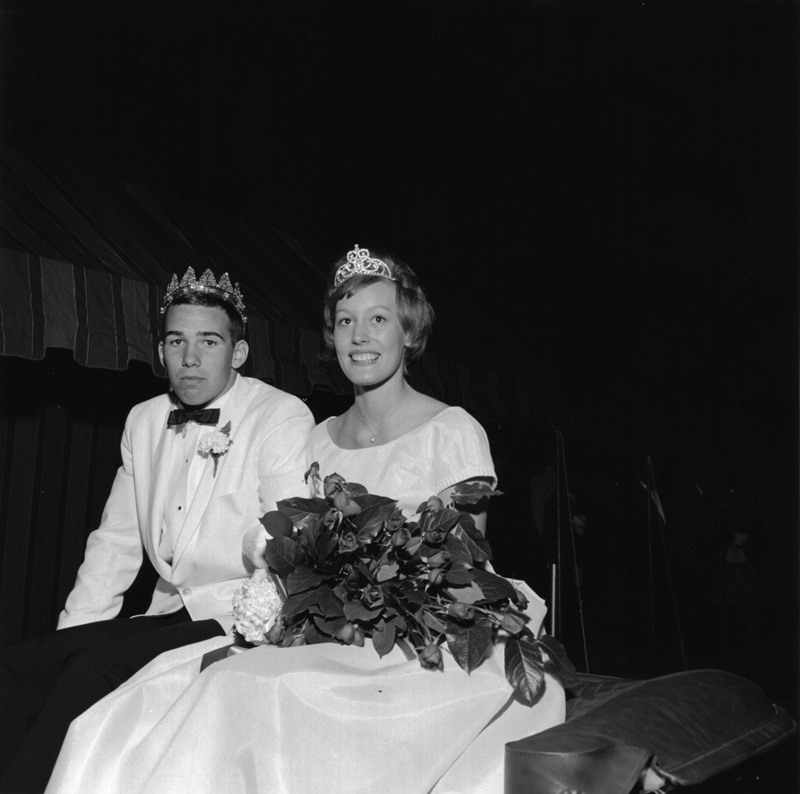
Take this picture from the 1963 Racine prom: The high schoolers aren’t about to start collecting their Social Security checks, but nor does the word “Whooooooooo!” appear to be emanating from their lips. The guy, in particular, seems to have a world-weariness that doesn’t seem in keeping with either prom season, or even the general culture that (I’m told) was the norm during the Kennedy/Camelot era.

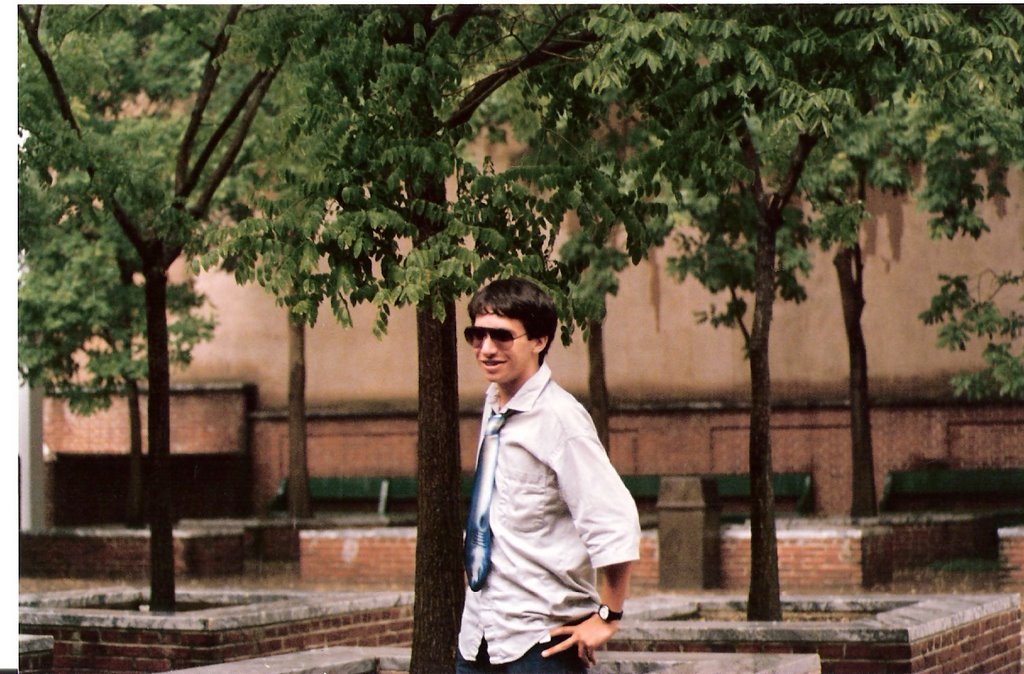
Flash forward 24 years. Around a generation later. High school seniors, as represented by this ill-advised picture of me taken in front of Independence Hall in Philadelphia, have become, well, doofuses. Somewhat innocent doofuses, but still, not quite the quasi-adults from the 1963 picture. In my defense, I’ll point out that the photographer and I had just run through a rainstorm. (I’m not sure there’s a defense for my fish tie.)

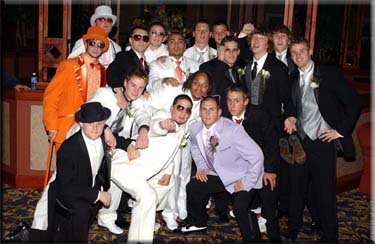
And yet, both the 1963 and 1987 photos attempt to convey some level of maturity (at least that’s the only legitimate explanation I can come up with for the fact that I was wearing a tie), which places them in something of a contrast with a recent prom picture I ran across from a high school in Ohio. I’m not certain, but I’m not sure “the verge of adulthood” is necessarily the image this picture’s subjects are trying to get across. What, exactly, the message might be, I can’t say for certain. (“MTV reality show viewing audience” might be a good start.)

But these things have a way of coming full-circle. Which is why I should start searching for cat’s eye glasses and an Audrey Hepburn dress for my daughter’s senior prom, scheduled for May of 2022.

Sunday, May 14, 2006

Why aren't there Pulitzers for random photos?

We were talking photography a little while ago here in the 19 Minutes World Media Headquarters - specifically, sports photography. For those of you who missed that conversation, and didn't bother to follow the convenient link above, I'll recap:

I've taken a lot of pictures of sporting events, for no particular reason, and with equipment that often doesn't quite fully capture the emotion of the event. For example, when I was a young person, I took a fair number of pictures of baseball games with a Kodak Instamatic camera, which did a fine job of taking pictures of the scoreboard, but - especially from the upper deck of Baltimore's Memorial Stadium, did less well at capturing diving catches or plays at the plate.

I ran across a lot of these pictures as I was preparing to move from Arizona to Wisconsin several months ago. Packing also allowed me to uncover an interesting contrast between my wife and me, picture-wise. Growing up, I took a lot of pictures of sporting events, mountains, ducks, cars, and people with Mohawk haircuts on London street corners. My wife took lots of pictures of friends. To this day, I can't remember whether I just didn't have any friends, whether I considered the ducks and the mohawk-wearers to be my friends, or I just didn't bother taking any pictures of them.

But at least all of my pictures (and my wife's) were of something - there was a clear subject and a purpose to the picture.

This is in stark contrast to one picture I also ran across. I know exactly where it was taken (the hallway in front of the gym entrance at John F. Kennedy High School, Silver Spring, Maryland). I know exactly when it was taken (March 25, 1987, and God alone knows why I know that). And I know the circumstances surrounding the activity in the picture (the District 1 concert band competition, which our high school was hosting, and which our jazz band was staffing).

Here's the picture:


I'm the random guy in the middle, wearing the sweatshirt that says "Guides". (It was a Maine Guides minor league baseball team sweatshirt. I'm pretty sure I was the only guy at Kennedy High School with one of those.) My jazz instructor, Ron Kearns, is the smiling guy whom I'm just about to hand the envelope, or who just handed the envelope to me. I think, even, 18 years later, I can identify some of the other people in the picture (including a guy named "Doug", and my non-prom date from a previous post. I also think my ninth-grade biology teacher is in the picture, which doesn't make a great deal of sense, considering the context, but you never know.)

So the picture raises a number of interesting questions, which we'll handle in the order they occur to me as I wait for my 2-year old to wake up from her nap:

1. Who took this picture? Given that it's in black-and-white, it strikes me that it might have been a yearbook photographer. But wouldn't the yearbook have wanted pictures of the actual band competition, as opposed to random people milling around in the hallway outside the competition? I'm also not sure what the people from Abraham Zapruder High School were up to that day. Or

2. Why did this person take this picture? A question that we sort of dealt already. But we should also note that it's in focus, the lighting is decent, and no one's head appears cut off. So it's likely that it was at least taken intentionally.

3. Who (or what) was the subject of this picture? Granted, I'm sort of in the middle, but I'm not exactly doing anything interesting. Mr. Kearns is smiling, but not paying attention to the camera. So perhaps the photographer was tasked with capturing the magic of people milling around a high school hallway. Or perhaps he or she was hoping someone would write about the picture 18 years later.

4. How did I come into possession of this photo? Whoever developed the picture must have looked at the negative and - even realizing that it was a picture with no clear subject - went ahead and printed it, possibly only to pass it along to me. Which means I must have known the photographer, making the answer to Question #1 that much more mysterious.

So, to recap: We have here an 18-year-old picture that includes me, but features no particular subject nor any real artistic merit. And yet, I've held onto it for nearly two decades.

Why? My theory is that everyone of us has one of these pictures taken in our lifetimes - a picture that captures us in a context normally out of the realm of photography - and in doing so, actually gives us a glimpse of what we were like at that moment in our lives. (In my case, kind of doofy.)

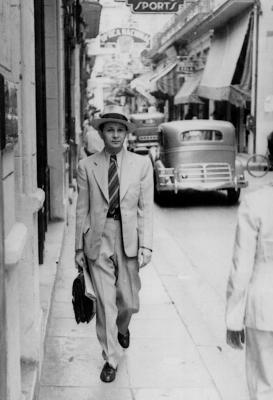
But consider this picture of my paternal grandfather, taken on the streets of Havana, Cuba, in 1939.It differs a bit from "Kennedy High School Hallway" in that he was clearly the subject of the photo. Yet, the contextual questions remains: Why take a picture of a random guy walking down the street in Havana? And then, how do you get that picture to its subject? Do you stop him, midstride, and say, "Excuse me, random person walking down the street: I've just taken your picture. Would you like a copy of it, so future generations can write about it, 67 years from now?"

Or, maybe it was an automated sort of thing - the 1939 Havana equivalent of those cameras that automatically take pictures of people on the Flume Ride in the Wisconsin Dells.

I don't know. Maybe I should have taken the nap and let my two-year-old finish this post.

Wednesday, May 10, 2006

Art imitates life imitating art etc.

Just for amusement, I'll be on Milwaukee Public Radio tomorrow talking about essentially what I blogged about last night. Unfortunately, I won't be appearing on the program alongside any criminal profilers or psychics.

(I should note that being on my own program wasn't my idea...)

Tuesday, May 09, 2006

When are we going to talk baseball?...Wait, isn't this the Mark Grace Show?

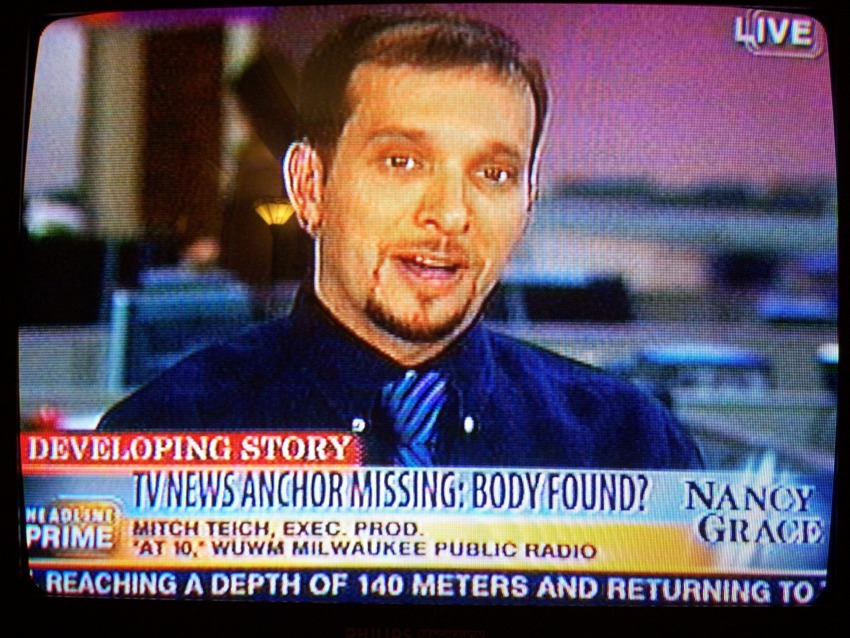
So, yeah. I was on "Nancy Grace" tonight, on CNN Headline News. (Really. You can read the transcript.)

Much to my surprise - and the surprise of my colleagues with TV experience - the producers didn't change topics 30 minutes before air, and I didn't get bumped from the show. The car that picked me up was on time, the local station from which I was uplinked was expecting me, and there were no technical difficulties once they patched me through to master control in New York.

The surprising part was that I was basically on the show as the expert on the history of a missing person case that's more than a decade old - a case that I only really covered when it first broke. The fact that I covered it and that it happened so close to home has led me to follow developments more closely than most of the other stories I covered in 1995. (Whatever happened to that strike vote at the Hormel plant? Uh, next question.) But it's not like I've written a book on the case.

But hey - the more interesting part is about what the whole "Let's Appear on Nancy Grace" experience was like. For those of us in the public radio world (at least those of us not named "Cokie"), TV is a mysterious place, where you have to be careful about where you're looking when the camera is on, and they string mysterious wires down your shirt and up your back.

But I figured some of it would seem familiar, since - hey - I actually produce a daily talk show. Right off the bat, one major difference:

Mitch's talk show: Guests drive themselves to the station. If they remember to bring their parking stub in with them, we can validate it. Otherwise, tough noogies.

Nancy Grace show: Limousine picks up guests. Drives them to the studio. Driver waits, then drives them back again.
I got to the studio (in the newsroom at the Milwaukee NBC affiliate) around a half-hour before they needed me on the set, so I passed the time by perspiring freely and running to the bathroom roughly every 4 minutes. Also, since I hadn't expected to be on television when I left for work in the morning, I had run out and secured a new shirt for the occasion shortly before leaving for the studio. Of course, when I got there, I immediately got paranoid about whether the sleeves looked too long. I asked roughly every TV person I could find whether the shirt looked okay, and they all said it did, though - now that I think of it - none of them actually looked at the shirt when they said it.

So after 35 minutes, they moved me over to the set, which was a tall chair behind a podium, all on a riser slightly above the main level of the newsroom. This basically yielded the classic shot of the guest in front of what would have been a busy newsroom, had it not been 7:00 at night. Frankly, I had hoped for one of those city skyline backdrops, but I guess I'll have to do Larry King for that.

The local engineer wired me up with my earpiece, which for some reason is called an IFB, and connected the lavalliere microphone to my tie (also a new acquisition). I did the mic level check with a producer in New York, quickly ingratiating myself with her for doing more than just counting up to ten into her ear (I talked about Product 19, if I'm not mistaken). I continued to work on my new hobby of perspiring.

Ten minutes later, we checked mic levels again, by which point I had developed new material to say in lieu of counting ("You know, if I had known I was going to be on TV today, I would have been more attractive," and "If the camera adds 10 pounds, can the 10 pounds be mostly hair?"). The kind of stuff that was far more glib than anything I actually said on the air.

Actually, the show itself was fine. "Nancy Grace" feels a little different than a public radio talk show. For starters, the opening music was far more dramatic. ("You know, if I had known I was going to be on TV today, I would have worn my Darth Vader mask...") And throughout the show, little dramatic music stingers would come out of nowhere - presumably to illustrate something, though I was busy concentrating on not looking at the monitor, so as not to seem so shifty-eyed that a casual viewer would think I was a suspect.

I was the lead guest - which was fine, except that there was no real explanation for why a guy from Milwaukee Public Radio was talking about this case at all. We did some Q&A for a couple of minutes (or 3 hours, I'm not really sure), and I only bungled one part of the story. Then, she brought in another guest. And another. And several more. All of a sudden, she was interviewing a criminal case profiler. And one of Jodi Huisentruit's colleagues. And then a psychologist.

Stranger still, she introduced each one of them by saying something like "Let's go back to...", as though they had been guests on a special pre-show that the rest of us hadn't seen. As far as I could tell, I was the only guest she could go "back" to, and so every time she said "Let's go back to..." I would perk up, ready to answer a question, then exchange amused glances with the engineer. And go back to perspiring.

So she brought in something like seven guests over the next 20 minutes, and by 7:30, I figured I was done for the night. I was even feeling relatively dry, or at least less-damp. Then, all of a sudden, I was History Expert Dude again, and finally got to point out that I had been a reporter in southern Minnesota when the story initially broke.

The on-air highlight (aside from the commercials, I suppose) came when Nancy Grace asked me whether the local police had ever excavated any of the farm fields in the area after Huisentruit disappeared (particularly the one in the news today) - and if not, why not. I pointed out that since, essentially Mason City is located in the midst of roughly 46 billion farm fields, it would have been tough to dig up every single one of them.

"Mitch, Mitch, Mitch," she replied. "I'm a farm girl from Georgia - I know how rural farm country is." I have no idea whether she was agreeing with me, or trying to get me to say something else further, so I nodded broadly (a gesture I had decided would work well on TV) and went back to describing how rural northern Iowa is.

The whole segment lasted about 40 minutes, which is either impressive for TV, or a testament to how desperate cable outlets get when it comes to filling 24 hours a day with news. It also included a couple of phone callers, who also seemed to materialize from nowhere. But no one shouted, and even considering Nancy Grace's, um, brusque style, the whole thing stayed pretty civil. I'm not sure 40 minutes on Headline News brought investigators any closer to finding out what happened to Jodi Huisentruit. I hope it did.

And if nothing else, my limousine driver turned out to be a very nice retired botanist who had been featured in the Milwaukee Journal-Sentinel last year, and might make a good guest on another - more local - talk show.

Tonight's TV fun, the preview

To save you the trouble of hunting through my blog archives, here's a reprint of last July's blog post about missing anchorwoman Jodi Huisentruit. It's interesting to note that the entry was posted at 1:10 am, which tells me that even 10 years later, I was losing sleep over the story:

Saturday, July 02, 2005

Searching for Jodi

ABC’s 20/20 tonight (2005) repackaged a piece they first ran five years ago, on the disappearance of Jodi Huisentruit, a morning anchorwoman in Mason City, Iowa.

This week marked the 10th anniversary of her disappearance on the way to work one otherwise unremarkable morning. Mason City, and KIMT-TV is part of an odd media market. It’s the CBS affiliate. The ABC station is in Austin, Minnesota, and the NBC affiliate is in Rochester, Minnesota. Ten years ago, I was a reporter at Minnesota Public Radio in Rochester. The Huisentruit story was the first piece I ever produced for National Public Radio. I’ve done probably 30 since then and hundreds of local stories, and it’s still the only story I’ve ever done that still gives me chills.

I met Jodi Huisentruit a couple of times, though not actually when I was working in Rochester. We traded contact information on sources when I worked down the road from Mason City, in Decorah, Iowa. If I remember correctly, she had moved up to Mason City from Cedar Rapids about the same time I moved up from Cedar Rapids, because I also remember watching her there. The 20/20 story included a piece of tape of Jodi Huisentruit reporting in front of a farm park in Decorah. My first story in Decorah was about that farm.

The 20/20 piece – like most of the national coverage of the case – got the story both right and wrong. To portray it as a small town’s loss of innocence oversimplifies it. I had a tussle with my editor over just that point. He wanted to hear that people were
locking their doors, looking over their shoulders, and worrying that life in Mason City would never be the same.

My reporting told me that only the last point was really on target. I was 26 and it was my first NPR piece, so I lost the argument. In fact, this is how my story ended:

"Investigators have called off the searches of nearby farmland in the
Winnebago River. They're now focusing on who Huisentruit may have seen or spoken with in the days before her apparent abduction, but police, community members, and reporters, all say that no matter how the case ends, Mason City will be changed. Front doors will be locked, people will look over their shoulders, and the early morning news will feel just a bit different. For National Public Radio, this is Mitch Teich reporting from Rochester, Minnesota."

The point was that most people in Mason City were no more worried that Jodi’s fate would happen to them than people in New York would have been if Dan Rather was kidnapped off the street. The likelihood was (and still is) that Jodi Huisentruit met with foul play because she was a celebrity in a place that had few celebrities.

In Mason City, and Rochester, and Flagstaff, Arizona, you can run into the local news anchor at Perkins. And that intimacy is both what makes living in places like Mason City special, and makes the disappearance of someone people know from television – and from the laundromat – all that much more difficult to take.

And as someone who’s worked in the media in small cities in Iowa and Minnesota and New York and Arizona, that’s why the goose bumps still come. Rochester, Minnesota – more than anywhere else I’ve worked – was filled with bright reporters from every media, who all genuinely enjoyed hanging out together. Maybe it was because, at the time, we all wanted to be somewhere else, but it was remarkable that so many people from TV, radio, and print welcomed each other’s company at settings besides press conferences. I interviewed a few of the women I knew in TV for the NPR piece I did ten years ago. And the vulnerability they were suddenly struck with in late June 1995 hangs with me today. It’s a depressing fact of media life that women in the broadcast media are subject to far more of the crap that comes with celebrity than men. It was the reporters who were looking over their shoulders.

Which is not to say that men are immune. My first paying job in radio was a one-night a week stint as the overnight DJ at a radio station in Cedar Rapids. I was to go on Thursday night at 11:00 pm. I trained in with the guy that did the overnight shift on Wednesday evening. His last piece of advice came at 5:30 the next morning. “People will call and offer to stop by and bring you food,” he said. “Whatever you do, don’t let them in.” The first food offer came the next night.

It’s probably worth noting at this point that 10 years later, Jodi Huisentruit’s disappearance has yet to be solved. The Mason City Police Department is still actively investigating the case. They’re at (641) 421-3636.

Um...

...a northern Iowa farmer believes a blip that ground-probing radar found in the ground on his farm is the body of a Mason City anchorwoman, missing for almost 11 years.

And thus, I'm scheduled to be on the Nancy Grace program on CNN Headline News tonight - thanks to this blog entry from last year.

More developments as/if they happen.

Friday, May 05, 2006

The Adventures of Orville Redenbacher in Prague

As noted in a previous post in this space, the bus system that whisks me to and from work features a TV system showing a network called "Transit TV". Transit TV runs all sorts of useful and appropriate features for a 7:30 am commute, like last night's weather forecast, trivia questions about Monty Python movies, the esoteric lead paragraph of Reuters news stories about Fortune 500 executives, and other topics sure to interest the Milwaukee bus riding crowd.

I wrote this as a member of the minority on the bus who actually knew the answers to most of the Monty Python questions, and the "Who Am I?" features about Calvin Coolidge. But this morning, Transit TV one-upped me.

Who, in God's name, were they expecting to reach with this question?:

"What petition called on Czechoslovakia's communist authorities to respect the international human rights agreements they had signed? The document was drafted behind closed doors in late 1976, initially signed in Prague by some 300 people, mainly dissidents, and was released to foreign correspondents in January 1977."

The answer, of course (which the 17 foreign policy experts on the bus would have shouted out, had there been 17 foreign policy experts on the #44 bus), was "Charter 77."

The following question was a fill-in-the-blanks spelling puzzle, the answer to which was "Cheese Popcorn".

Saturday, April 29, 2006

A prom story

Darn you, Beth-Anne Lapsley. If I'd had even 1/10th less of a crush on you in 1987, I could have actually asked you to the prom, and I wouldn't be stuck telling the same damn story every spring.

I didn't go to the prom my senior year of high school. Or my freshman, sophomore, or junior years, either, but that seems to be less of a big deal.

And really, it's not that big a deal anyway, except that over the past 19 years, talk at this time of year always comes back around to prom season. It was still a little raw while I was in college, so I used to mutter my no-prom story through clenched teeth and duck out of the room to go watch the Stanley Cup playoffs.

The past 15 years in the news business, proms frequently end up the topic of potential-news-story conversations, like "How much are kids spending on limousines these days?" and "Can you believe how much kids are spending on limousines these days?" and even "When I went to prom, it was in my mother's 1984 Ford Escort, not one of those dang limousines". Nobody says reporters are always a creative bunch.

And my story now ends up as comic relief. I spent much of my prom night in my car in a Wendy's parking lot with Jonathan Blatt, with both of us complaining about how we couldn't get dates. (It might have been his car, now that I think of it. On the other hand, I believe they were both Ford Fairmonts, so the mental image is pretty similar). Then he went off to another friend's house to complain about the same thing, basically, while I went home and watched the Stanley Cup playoffs.

Of course, what never got said in the car was that it was my own fault I didn't have a date. I had wanted - planned - to ask Beth-Anne to the prom for roughly 786 weeks. I got to six out of the seven digits in her phone number several times before chickening out.

(It was that kind of crush. And yes, I did that enough that I still have the phone number rattling around in my memory instead of somewhat more useful information like my daughter's social security number.)

So, a couple weeks before Prom Ground Zero, I finally arrived at a plan that would involve my asking her in the hallway in between lunch and jazz band class (Do I miss high school? I do not.). And that plan was instantaneously dashed two classes before lunch, when Jeff Cohen mentioned he had asked Beth-Anne to the prom the night before - just as friends.

I spent most of lunch, if memory serves, slamming my forehead into my locker, which may account for my hairline today, or at least my inability to remember my daughter's social security number.

And I'm sure they had a fine time. I stayed friends with both of them afterwards, and my romantic life continued on that same trajectory for a while longer, as I also managed to not ask Beth-Anne to dinner or to the movies.

So Beth-Anne, I'm sorry. I still wish I'd managed to ask you to the prom. Not because I imagine my life would have turned out differently in any major way - I have a wonderful wife, the cutest little daughter on the planet, and an amusing story to tell every spring. And not because I'd rather tell a story about an actual prom experience, rather than a Wendy's parking lot story. ("...the cheeseburgers were terrific.")

I just think we might have had a nice time.

Wednesday, April 26, 2006

Getting out of touch with my inner Grammar Snob

First off, as I pop another Junior Mint in my mouth, I'd like to thank the people at Junior Mints for finally explaining the name of their candy right there on the box, even though their explanation doesn't, technically, make sense:
Over Fifty years ago, a new "Star" was born. Given Junior Mints' popularity at the movies it comes as no surprise that the brand was named after a top Broadway play in 1949: "Junior Miss"!
I'll note only that I'm not sure why the fact that the candy is popular at the movies has anything to do with the fact that it was named after a Broadway play. If movies hadn't existed in 1949, maybe I'd be ready to make the cross-cultural leap. Or if they had referenced the candy's popularity at "the theater", I'd be with them.

Regardless, that's the only point I'll make about this particular piece of copy writing, and so I'll refrain from pointing out the random capitalizations, odd use of quotation marks and dubious exclamation point. That's because I'm trying - really trying - to avoid being pigeon-holed as a Grammar Snob.

Back here in 19 Minutes World Media Headquarters, I conducted an interview this morning with one June Casagrande, author of the very funny "Grammar Snobs Are Great Big Meanies", which takes to task people who derive an unnatural amount of pleasure from catching the grammar mistakes of others.

I was a little concerned as I began reading her 194-page screed. First, I find myself using words like "screed" that no normal, Vanilla Coke-drinking person would work into casual speech. (Second, I drink Vanilla Coke.) And I have a long history of nailing people for errors in print.

My first college, for instance, asked me to remove myself, Felix Unger-like, from my place of residence (college, that is), ostensibly because my GPA couldn't be spotted with an electron microscope, but really because - as managing editor of the campus newspaper - I spent hours (and hours) finding every conceivable error. And then printing out the correction, cutting it out, coating it with hot wax, hunting for where I dropped it on the floor, finding it again, and sticking it on the galley. Needless to say, this left me with little time for what some people liked to call "classes".

A year-and-a-half and two colleges later, the editor-in-chief asked me to stop helping out at her paper, because I was spotting too many mistakes.

"We're not trying to be a Nobel Prize-winning newspaper," she said.

"You mean a Pulitzer Prize-winning newspaper," I replied.

"I think you should leave," she concluded.
Around the same time, I found a typo on the beautifully caligraphed marriage license my aunt and uncle had commissioned for their wedding. Even I cringed a little when I pointed that out.

And more recently, regular readers of this fine feature (or fine readers of this regular feature) will recall that I took the late Fred Rogers to task for naming his program "Mr. Rogers' Neighborhood", rather than "Mr. Rogers's Neighborhood", which "The Elements of Style" dictates.

As June Casagrande pointed out in her interview this morning, Mr. Rogers may well have been following the AP Stylebook when he named his program, so I hereby retract my complaint, and will continue to (try to) relinquish most of my worst Grammar Snob impulses.

I will, however, continue to wonder where Mr. Rogers was coming from at the beginning of his show, and where he was going at the end.

Saturday, April 22, 2006

Clearing out the backblog, vol. 1

Here at the 19 Minutes World Media Headquarters, we've been hip-deep in the reality that is being the executive producer of a daily interview program. This should mean nothing to you, the 19 Minutes reading faithful, except that it's been hard to post regular updates - especially this week, as we've also been filling in as the host of the show.

The upside is that our brain's memory cache has been filling up with column material. The downside is that as new stuff shows up in our mind, some of the old stuff finds itself filed in our brain's recycling bin. (We'll stop the extended Windows metaphor any minute now.)

So we're left with a bunch of stuff that could best be labeled "quick hits" - stuff that could be worth 750 words, but will end up being represented by two or three fascinating paragraphs. At the very least, they'll be easier to print out and post on your refrigerator, should you happen to want to post any of them to your refrigerator, which you probably don't.

(On a related note, who decided that refrigerators were the kitchen appliance of choice for posting shopping lists, artwork de les enfants, or tickets to upcoming baseball games? Why aren't we posting these things on our dishwashers? I can understand why they don't end up on our waffle irons, but the side of an electric can opener is just wasted space at this point.)

Anyway, this is the freshest material we have to work with.

A hypothetical: Let's say you're a guy. (Actually, for the 19 Minutes staff, this isn't really a hypothetical.) When you're a boy, say, nine years old, and you're at a sporting event, you spend roughly one-eighth of your time watching the game, one-eighth of the time dripping hot dog mustard on your t-shirt, and three-quarters of your time trying to con the players, coaches, umpires, linesmen, bat boys, the old guys sitting in the right field corner who scoop up the foul balls, groundskeepers, and photographers in the camera bays to throw you a ball, puck, batting glove, cracked bat, broken stick, pine tar rag, sweat-soaked towel, or empty bag of sunflower seeds.

This almost never comes to fruition, since a) you're not being very polite about it, b) there's no compelling reason for any of these people to throw you anything since as a nine-year old, your bribery options are somewhat limited ("Come on, I'll trade you the Pog chip that's in my pocket..."), and c) there are roughly 650 other nine-year old boys crowded around you trying to accomplish exactly the same thing.

So every once in a great while, the bullpen catcher or the backup goalie will toss a batting practice baseball or a warm-up puck into the crowd, purely for the amusement of watching 650 nine-year old boys attempt to kill each other to take possession of this sacred talisman of sports fandom worth $.49 to the team in question.

Having just packed a household and moved it across the country, I recently came across one of the few such treasures I collected in my youth - a baseball rolled across the dugout to me at Memorial Stadium in Baltimore by vaunted-yet-obscure Red Sox pitcher Allen Ripley on May 23, 1979. I know these facts surrounding this baseball, because written on it, in green ballpoint 10-year old handwriting, is the inscription: "Rolled across the dugout at Memorial Stadium by vaunted-yet-obscure Red Sox pitcher Allen Ripley - May 23, 1979." Okay, so I've added the "vaunted-yet-obscure" business 27 years later. Also, my handwriting has improved. Or at least changed.

Now let's go to another hypothetical. You're a girl. Specifically, you're a 22-month old girl at Game 1 of the first round of the AHL's Calder Cup playoffs - Milwaukee versus Iowa. You're wearing your Ottawa Senators jersey, in part because it makes your dad pleased, and in part because it's the only hockey attire you own, save for the paper hockey helmet obtained from the Frozen Four Skills Challenge a couple weeks ago.

You spend roughly half your time pointing and/or waving cheerfully at the hockey players who are busy slamming each other violently into the dasherboards, a quarter of your time eating Wheat Thins, and a quarter of your time walking back and forth in front of the three seats you and your parents occupy in the second row behind the visitor's bench and trying to get at the old french fries under the seats. In short, you are not requesting anything at all from the players, referees, equipment managers, ushers, or your fellow fans.

This means, naturally, that after the horn goes off at the end of the second period, a referee hands off the game puck to a fan sitting nearby, who of course tosses the puck to you. And it means that after the game, when you - at 2-feet-5 - want to walk through the crowd on the concourse towards the escalators roughly a half-mile away, the crowd parts to watch this miniature person wearing a hockey sweater making her way towards the exits. And then another girl - probably around 10-years old - walks over and offers you her inflatable 'cheer sticks'. And so now you're walking through the concourse, holding two inflatable sticks almost as tall as you are, oblivious to the fact that even more people are now charting your progress, watching you like the citizens of Boston in "Make Way for Ducklings". (Only instead of the man who sweeps the streets saying, "Now, ain't that nice," it's a guy in a Milwaukee Admirals jersey, holding a beer, saying "I think that's the smallest person I've ever seen.")

And so, of course, a woman wearing an Admirals staff nametag stops by and hands you a foam rubber puck, telling your parents not to worry because you can't hurt herself with this one. And so you set down one of your cheersticks and cheerfully carry the puck for a while until you hand it off to mom and re-collect your second cheerstick.

On you march, the crowd continuing to part, and cute college girls bending over to pinch your nose. And then another Admirals staffer walks up, and says, "Ah... I was looking for someone to give this puck to..." and you wind up with a brand-new game puck, too.

Again, let me stress that this 22-month old did nothing to solicit any of these items, except to look heartbreakingly cute as she went about her business at the Bradley Center.

And you know what? You are pretty darn cute.

Friday, April 21, 2006

We're Number 16! Rah!

A little insight into Milwaukee’s current sports psyche…

Yesterday morning, I walked over to the Bradley Center box office to buy tickets to the Milwaukee Admirals’ (yes, that'd be minor-league hockey) playoff game tonight against Iowa. It was 11:20, and there were about 10 people in line. It dawned on me that Bucks’ NBA playoff tickets were also on sale, which probably accounted for the brisk business on a Thursday morning. Of the 10 people in line, it turns out six of us were buying Admirals tickets, two were going to some circus that was actually going on that morning, and two were buying Bucks tickets.

Headline in today’s Journal-Sentinel sports section:

Not Much Expected of Bucks

Nice to see rampant optimism infusing a city…

(Of course, this may also have had something to do with the fact that 4th-row seats at the Admirals game cost me $9.00 each, while 4th-row seats for the Bucks-Pistons would cost $115. If they were available. Which they aren't.)

Friday, April 14, 2006

Taking a shot at sports photography

I’m going to a hockey game this evening. The Milwaukee Admirals are playing the Chicago Wolves – a game that, if it weren’t an actual minor-league match, would sound like a made-up event from an episode of MacGyver. (After which the players would kick back and take a swig out of a bottle labeled “Cola”, or perhaps “Beer”.)

But it’s a real game, and to prove it, I’m planning on bringing my camera. I’ve taken a lot of sports pictures in my life. I have no idea why. It was a habit that I thought began when started lugging my Nikon EM to Red Sox games when I was a teenager. But when we were packing things up to move to Wisconsin, I discovered a bunch of pictures from a Baltimore Orioles game in the late 70s (I’m assuming they were playing the Red Sox). They were taken from the upper deck of Memorial Stadium, using a Kodak Instamatic and its classic 126 film, which means you need a magnifying glass to verify that, the people in the 3X3" pictures are, in fact, baseball players.

The problem is – starting with the aforementioned Kodak Instamatic, I’ve never really had the right camera for shooting sports. I’ve had decent zoom lenses, but never the variety that allow for close-ups that convey any kind of emotion, the way a Sports Illustrated picture does. So what I’m left with are basically sports landscapes – nice shots of the ball in motion as the batter begins his swing, or of the football kicker just after he’s lofted the extra-point over the offensive line, or hockey players about to take a face-off. I get Lens Envy whenever I run into a professional photographer at games.

My wife and I made it to the 2002 Winter Olympics in Salt Lake City – an opportunity for us to practice our skills at shooting pictures of bobsledding. As it turns out, it was nearly impossible to take digital pictures of a bobsled roaring by at 85 mph, since our 2001 digital camera had a maddening delay between the time you pressed the shutter and the time the camera actually took the picture. So, until we got wise and went to the end of the run (where the bobsledders actually stopped), we got a lot of inspriring pictures of empty bobsled track. (Thrill of victory, indeed.)

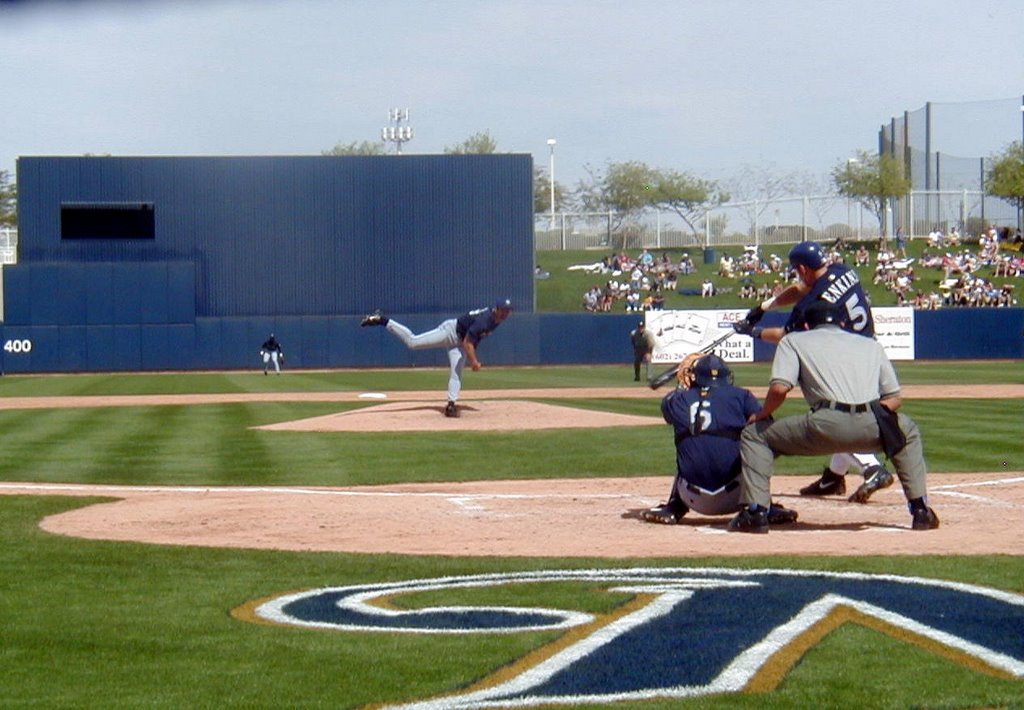
So I’ve discovered that the best places to take sports pictures are at exhibition events – such as last weekend’s “Frozen Four Skills Challenge”, which showcased the talents of the best men’s and women’s college hockey players in the country. That’s because everything happens eight or nine times in a row – each competitor skates around the same cones, sprints around the same track, and shoots at the same goal. So after taking more pictures of empty ice, I could adjust my technique and gradually work my way to pictures of a skater’s heel, and finally on to the point where there was a real-live person in the frame. (The women hockey players – such as North Dakota’s Devon Fingland (above left) – who were a step or two slower than the men, were easier to capture.)

Anyway, I’ll probably take my camera to the Admirals game tonight. We’re in the upper deck, which will pose some challenges, even with my 2005 digital camera and its 10x optical zoom. So maybe I’ll see if I can dig out that old Kodak Instamatic.

You otter be doing something else

A news update, from the 19 Minutes World Media Headquarters: As of Friday afternoon at 3:00 pm CDT, a full 29 percent of the hits this feature has received in the last month were from people looking for pictures of river otters. To date, we've never run a picture of a river otter (which makes this fact all the more astounding).

So to avoid any further disappointment by people who have reached this page looking for pictures of river otters, here's the best we could muster from our trip to the San Diego Zoo last fall:


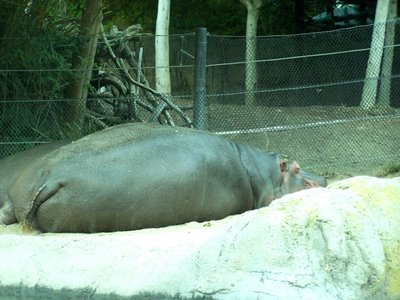
And, just in case there's anyone out there using the search term "drowsy hippopotamus", here's a special Friday afternoon bonus:


A request, though -- for anyone who starts a garage band and calls it "Drowsy Hippopotamus", I'd like a credit in the liner notes.

Tuesday, April 11, 2006

Guardedly optimistic about DST

The 19 Minutes staff has called the Milwaukee area home for around six weeks, and we continue to marvel at quite a few things we experience every day. Daylight Saving Time, for starters. After seven years in Arizona, Daylight Saving Time took me by surprise.

Not the setting-the-clocks forward part, of course. You have to have live in a Habitrail, turned away from all forms of media, to miss the helpful reminders to set your clocks forward. I believe even Iron Chef Chinese, Chen Kenichi, took a few seconds out of the Rutabaga Battle to remind Americans to set their clocks an hour ahead.

The aspect that threw me was the part where it actually stays light later in the evening. For the first week after we sprang forward, I was continually confused by the visual cues around me – convinced it was earlier than the clock claimed. But after getting used to it, I have to give it a pretty favorable review. Not only is it nice to get home from work in daylight, but I could now get things done in the garden, should I suddenly develop an affinity for gardening.

The Milwaukee area also continues to dazzle me by its amazing proliferation of crossing guards. There are probably half a dozen schools between my house and the park-and-ride lot, and each of them has a platoon of crossing guards at the intersections nearby. These are adults wearing bright orange jackets or vests, and who carry hand-held stop signs to let children get to school more quickly and safely.

Or you would imagine that is their charge. The reality is that Milwaukee-area crossing guards are a little scattershot. Maybe it’s their training program. When I was a crossing guard, at Glenallan Elementary School (the crossing guard program against which all others are judged), Officer Barnes instructed us to wait until a group of children had reached the curb before having them all cross at once (perhaps to ratchet up the body count in the event of an accident).

The local crossing guard establishment favors a policy wherein they walk out and stop traffic to let one child cross, then head back, only to stop half-way to the curb as another child approaches, after which they stay out in the middle of the street to let a parent – fresh from dropping his child off at school – cross in the other direction. All this does wonders for the blood pressure of Milwaukee-area drivers, which is perhaps why the crossing guards want to keep any potential body counts low.

The crossing guards also are deployed at traffic lights, which seems like an interesting use of resources, considering there are already crossing guards at those intersections, in the form of blinking white guys and orange guys.

Our immediate neighborhood also features a guard known to all as “The Waving Crossing Guard”, who – not surprisingly – stands at her corner and waves at every single passing vehicle, which seems like an oddly distracting activity for a crossing guard to engage in.

And finally, this update on the "Woman Who Probably Has Her Hair Done Very Nicely, Only She Wears a Knit Hat On Top of It Somewhat Precariously, So We Never Actually See What It Looks Like", who often rides our bus, but whom we had lost track of: She has returned to our Freeway Flyer bus, and with the temperature reaching the upper 60s, has - in fact - dispensed with her hat. As it turns out, she sports a simple pony tail. So much for the mystique. We'll now have to scan the bus for another Mystery of the Ages. Stay tuned.

Some kind of harmonic convergence or something

So the 19 Minutes World Media Headquarters has relocated to downtown Milwaukee, within a few blocks of a variety of performance venues - among them, The Bradley Center, the U.S. Cellular Arena, the Pabst Theater, and the Riverside Theater. The last of these is worth noting because there's an alternative rock band called "Train" playing a concert there this evening.

I know nothing about this band, except that on a walk back to my office this afternoon (from the Bradley Center, no less), I passed the group's bus, parked across the street from the theater.

No sooner did I start thinking about the irony of a group called "Train" traveling by bus than a city bus came barreling by, with this sign above the windshield:

TRAINING BUS


That's all. Feel free to go back to your lives.

Tuesday, April 04, 2006

A bonsai buckeroo

You're driving down, say, Oklahoma Avenue in Milwaukee, Wisconsin on some Tuesday evening. You pass, roughly 173 taverns, 24 bowling alleys, and 5 Lutheran churches (hey, sometimes stereotypes are accurate). The last of these Lutheran churches is Grace Evangelical Lutheran Church, and the parking lot is filled to capacity. You figure, "Maybe a youth group. Maybe choir practice. Maybe they're making lemon bars."

You'd be wrong.

I've recently come from an assignment at the aforementioned Grace Evangelical Lutheran Church, where some 60 tiny tree enthusiasts were plying their trade. The Milwaukee Bonsai Society was hosting its annual "Group Slash" competition, and I was along for the ride.

Me, I always thought of bonsai trees as little junipers that city apartment-dwellers placed on their window panes when they got tired of looking at the little cactus garden they bought at Safeway.

Turns out that hundreds of people in the Milwaukee area alone are really into these things, and in a way that seems healthier than that whole Star Trek fancier phenomenon. Some of these folks have been working on the same tree for decades. The way the bonsai aficionados see it, their trees tell a story - a story that they've crafted by making it look as though the tree was hit by lightning, weathered by mountain winds, clear-cut by a paper company, etc.

But there was little time in the "Group Slash" for telling too complex a story. Teams of three or four (or more) people ganged up on the little trees and tried to turn them into something interesting in the span of an hour. College students, day laborers and senior citizens pulled, snipped, and wired their small plants into position. One participant was a middle school teacher whose 6th and 7th graders will hold a day-long bonsai workshop later this spring.

Some of them looked like high-elevation bristlecone pines, gnarled by years of harsh weather. Some of them looked like Charlie Brown's Christmas tree, scarred (physically and mentally) by poor application of pruning shears. But in a room saturated with the heavy, sweet aroma of juniper, the enthusiasm was infectious. And the lemon bars were tasty, too.

Considering the number of plants that have come and gone from my household, it's probably a good thing I wasn't tasked to judge the evening's results. But in the end, no one got hurt and a good time was had by all.

And I got a pretty good radio piece out of the hour, which should make it to air in a couple of weeks.

Monday, April 03, 2006

First pitch of the season

Before we get on with the ceremonial first pitch, a post-script to our "Thoughts on the bus" feature: We've already lost track of the "Woman Who Probably Has Her Hair Done Very Nicely, Only She Wears a Knit Hat On Top of It Somewhat Precariously, So We Never Actually See What It Looks Like", which means one of two things - either she's stopped taking the bus (after, perhaps, being directed to this column); or she's actually still riding the bus, only she's stopped wearing her hat, and we really don't know what she looks like.

Anyway, as you would know if you drove by Miller Park this afternoon (which you probably didn't), baseball season is underway. It's a different experience in the northern tier of the country, this opening day business. All that rhapsodic talk in baseball literature about the start of the season being tantamount to the planet's yearly rebirth is somewhat more pertinent in a place that's not green year-round.

Don't get me wrong: I enjoyed watching baseball for the last seven years in Arizona. There was something equally satisfying about buying sunscreen in late February and thinking about snow piling up on the pitcher's mound in Cleveland. And going to a game here in Milwaukee - in a domed stadium as we're planning to do this Saturday, will probably seem as unnatural as going to an August ballgame in Phoenix. Or an April hockey game in Phoenix. Or any hockey game in Phoenix. Or a Pesäpallo game in Michigan. (You can look that one up.)

But their shared artificialities aside, there are some key differences between the Arizona and Milwaukee baseball experiences that I'm looking forward to:

Tailgating. Driving by Miller Park this afternoon, you could smell the brats grilling in the parking lot. From the Interstate. Inside a bus. What I like about tailgating is that it gives the baseball game a more momentous feel - like an actual event, rather than a two hour TV show you're attending. When I landed my first radio job, I timed my drive from Maryland to Iowa so that I could go to an Indians-Yankees game at Cleveland's old Municipal Stadium. Eight thousand fans in a park that held 80,000.

The forlorn gravel parking lot was easily the size of Rhode Island, and as I pulled up - with a carful of worldly possessions - a minivan with West Virginia plates pulled in next to me, and a bunch good ol' Mountaineers hopped out and proceeded to assemble a phalanx of hibachis. (A side note: I believe 19 Minutes Past the Hour has just made history by being the only weblog in history to use the term "phalanx of hibachis". And you were here to witness it.) It turned out to be a group of four friends on their yearly trip to see the Indians, and they thought my need to see an Indians game on my move was so cool, they added another couple of Italian sausages to the grill and dealt me in. So I like tailgating. On the other hand, I can't fault Arizona Diamondbacks fans for foregoing the tailgating tradition. For one thing, grilling out loses some of its appeal when the pavement is hotter than your charcoal. For another, management frowns on grilling out in a parking garage, anyway.

The other aspect of Milwaukee baseball that I think will appeal to me is the team's desire to have me attend its games. We attended a lot of Diamondbacks games the first few years we lived in Arizona - which was saying something, considering it was a two hour drive from Flagstaff to the Stadium Formerly Known as Bank One Ballpark. The team was good, the ticket prices reasonable, and the seats were typically 2/3-to-3/4 full. Then the Dbacks started losing. And people stopped showing up. To which the Diamondbacks responded by first, increasing ticket prices. Then, they created a multi-tiered pricing system, which included something called "Marquee Games", meaning they jacked up prices some more for games that anyone wanted to go to (which included, if memory serves, an exciting interleague series against the Tigers). Our last season in Arizona, we made it to one game.

Flash forward to last Friday. It's raining. It's 40 degrees. It's windy. I stop at Miller Park on my drive home from work - it's about 8 minutes from my house. I drag my bedraggled self to the ticket window and remark that the experience is a little different than buying tickets in my former Arizona home. The vendor replies, "Well, for people who have just moved to Milwaukee from Arizona, we have a special deal - half-price on any seats in the house."

It turns out that he was being the slightest bit theatrical - the Brewers have a special deal on at the beginning of the season, offering half-price tickets to everyone in the five counties in the metro area. But they actually seem to understand that they'll do better in the long run if they draw 35,000 fans a game paying half-price than if they draw 11,000 fans a game, and most of them sit in the bleachers. The fans might even come back again, and pay full price.

So we're going to the Brewers game this Saturday. They're playing the Diamondbacks.

Monday, March 27, 2006

Thoughts on the bus

Reason #907 why I hope my 21-month old doesn't grow up too fast: She thinks it's really, really cool that I ride the bus to work. Sylvi loves buses. The "Hippopotamuses of the Vehicle World", she'd call them, if she could manage the verbiage. She can't quite manage that, though, so she's content to point out the car window and exclaim, "Bus! Bus!" whenever a bus goes by (or a garbage truck, for that matter).

So I'm riding the bus to work - or, rather, two buses. There's the humble, regular old surface street bus (the Number 76, to use the hepcat bus lingo), which connects me to the "Freeway Flyer", which looks suspiciously like the humble regular old surface street bus, only it goes on the freeway and takes me downtown.

The whole bus concept has taken a little getting used to. I'm not a complete novice to public transportation - I did ride Metro, the Washington, DC, subway system quite a bit growing up. But on the subway, you at least have the ability to figure out where the next stop is going to be. And it's not up to the riders to determine whether the train is going to actually stop. So at least until I got used to where the heck I was going (and more importantly, what that place looked like), I would perch over the "stop" cord for the last 10 minutes of my trip, certain I was going to miss my stop. Even then, someone else always beat me to the cord-pulling thing, blocks before we actually reached my destination.

Besides that, it took me weeks to figure out when to actually show up at the bus stop. The bus schedules in Milwaukee - as in most large cities, I'd imagine - don't actually list all the stops. Rather, they tell you when the bus will be at a few noteworthy stops, and it's up to you to extrapolate when you need to show up by the side of the road. This, of course, requires you to know at least a little about where the stops are, and what the traffic is like at a given hour. For a few days, I was varying the time I'd leave home. As it turns out, if I leave my house at 6:55 am, I get to work at 7:35. If I leave at 7:02, I get to work at 8:25. If I leave at 8:00, I also get there at 8:25, but only because it means I've missed my last bus and I've gone home and talked my wife out of the car for the day.

But riding the bus has also posed some other local adjustment questions, like: How long do you ride the same bus every day before you start to acknowledge the other people who also ride the same bus every day? People like the Guy With the Grey Hair and the Dark Moustache, who appears to teach at one of the colleges; the Woman With the Grey Overcoat; and the Woman Who Probably Has Her Hair Done Very Nicely, Only She Wears a Knit Hat On Top of It Somewhat Precariously, So We Never Actually See What It Looks Like. There aren't a lot of great conversation starters on the Freeway Flyer (provided, like me, you refuse to start yammering about the weather), so I'm inclined to wait until something unusual happens ("Hey, Guy With Grey Hair and Dark Moustache! I see the Woman Who Probably Has Her Hair Done Nicely has apparently purchased a new hat...")

I'm also interested in another phenomenon that's appeared on Milwaukee buses: Transit TV. A TV network even more inane than the CNN Airport Network. It's an interesting concept, though - TV monitors in buses, showing weather forecasts, recipes, commercials for predatory loan places, roundtable discussions of what the Woman Who Probably Has Her Hair Done Nicely's hair actually looks like - but the execution is pretty weird. On one hand, they show word puzzles of the "Wheel of Fortune" variety, with challenging answers like "Spatula". Then, they hit riders with a movie trivia question about "Monty Python's Life of Brian", followed by a 'Who Am I?' puzzle about Guglielmo Marconi. All this leads me to wonder: Who do the programmers think is riding Milwaukee buses? Are the people getting the Marconi question really going to head out to the car title loan place? Are the kids causing trouble on the buses going to stop what they're doing when they figure out the answer to _PAT_LA?

Maybe I'll bounce these questions off the Woman in the Grey Overcoat.

Wednesday, March 22, 2006

Home is where the house is

Author's note: The following was jotted down Sunday night on the back of a random sheet of paper I found in my blazer, composed after my seatback was up, and my tray table in its fully upright and locked position. It turns out the other side of the paper contained my notes from introducing the Capitol Steps when they performed in northern Arizona last year. That fact has no bearing on anything that follows.

I'm at 28,000 feet, in a Midwest Airlines Boeing 717. Nice spanking new airplane with big leather seats, free chocolate chip cookies, the whole works. It's a nice evening for flying. A little rough air (that proverbial "light chop" the pilots are always referring to, but not a cloud in the sky between northern Virginia and southeastern Wisconsin. And even though it's too dark to make out any landmarks, the spiderweb pattern of each set of city lights is distinct enough that I can figure out where we are - and right now, that place is just past Detroit.

I'm flying home to Milwaukee, which is odd, given that I've just left Washington, DC, which was my home for the better part of two decades. Odd, too, because the Milwaukee area has been home for the better part of four weeks. I have to consciously remind myself that I'm at the end of the trip, not the beginning.

The pilot's just come across the PA system, noting we're over central Michigan. He points out - marvels, really -- that it's such a clear night that we're still some distance from Lake Michigan, but he can already see the lights of Milwaukee, far on the other shore. My seatmate and I are looking out the right side of the plane, but it's not hard to imagine the skyline of Milwaukee, reflected in the calming evening water of Lake Michigan.

This is my first trip "home" since moving to Wisconsin last month. And though I'm not there yet, I'm thinking the landing at General Mitchell International Airport won't have the same level of intimacy flying back to some previous homes had. Flagstaff, Arizona, and Massena, New York are about as spiritually different as you can imagine, but their airports had two key similarities - parking lots that were a) free; and b) small enough that you could spot your car as you came in for a landing, thus saving you the trouble of trying to remember where you'd parked a week ago.

I had a love-hate relationship with Flagstaff, but it was home for the past seven years. When my wife and I moved there in 1999, it took almost no time to feel like a comfortable pair of jeans, already broken in. The problem was - like a pair of jeans - over time, it got small. Not claustrophobia-inducing, just small enough that it was harder to hide the imperfections. Bad Chinese food, an overbearing landlady, no place to buy decent donuts - and that's before you include an underfunded education system and 95 freight trains blasting through downtown every day and night.

But it was hard to pick up and move away from clean air, clean water, 310 days of sunshine a year, and a six-minute commute to work -- and that's before you include terrific friends, a terrific job, and even a terrific pediatrician. And the comfort of returning home to a too-small apartment with a too-large (and too-ugly) couch, where the two loves of my life sat watching "Mr. Rogers' Neighborhood".

The couch is still in Flagstaff. The loves of my life have moved on to a new couch and, truth be told, a new TV show of choice. But the new couch is in a new house, in the city that's reflected tonight in Lake Michigan.

So, Milwaukee. It's nice to be home.

Wednesday, March 15, 2006

Finding Cortez

First of all, an apology from the 19 Minutes World Media Headquarters, where we experienced the joy of an electrical system in an 81-year old house. We experienced plenty of windstorms back in Flagstaff - sometimes with 50 mph winds. None of them ever resulted in a power outage, nor affected our computer in any way. Meanwhile, back in Wauwatosa, we had 25 mph winds the other day, which not only knocked out our phone, cable, and internet service, but also zapped our power, and fried our hard drive. Two days and plenty of IT support later, we're back.

Onward.

There's an interesting magazine/website that focuses on pieces of writing on scraps of paper people have picked up off the streets. (So, in a sense, the wind is really a friend to undiscovered writers.) The concept is that there's a lot of unintentional-yet-authentic prose floating around in the ether.

I discovered that a while ago in a stint in the adminstrative assisting arts I pulled in between college and my first reporting gig. I started as a one-day temp in an obscure office at Georgetown University - until the person for whom I was filling in never bothered showing up again. That left me to comb through her computer files to finish the variety of projects she had left undone. That was when I discovered a treasure trove of heartfelt letters she had written to a relative, detailing a heartbreaking variety of medical concerns and relationship issues involving her family, all written in the style of Appalachia. It was as though I had stumbled onto the draft manuscript of an unpublished Lee Smith novel.

(Naturally, I took it upon myself to archive all of the letters, including a few unfinished works. I'd do something more with them, but tragically, I don't have access to a computer with either a 5 1/4" floppy drive, or that's still running WordStar IV.

So when the 19 Minutes World Media Headquarters moved into its vintage bungalow, I had high hopes for what we might find. Immediate rewards came in the form of a box in the garage with a bunch of VHS videos from the previous homeowners' collection - though my excitment was tempered a little by the sketchy taste they displayed ("For Love or Money"? Really? Someone bought that?)

Running shorts left in the laundry chute weren't much of an addition, nor the several dozen cans of paint in the work room, even though many appear unopened. I was rummaging around, looking for hooks in the work room, when I discovered an even less-promising archive of broken pieces of window glass and mirror. It was under that collection that I discovered the one piece of leftover prose: A sheet of notebook paper, with adult handwriting. It starts with this fascinating insight:

5. Cortez Watcher of the skies
It goes on to pose an obvious follow-up:

1. A person who discovers the soldier
What's wrong/why is he there?
But from this somewhat unpromising start, it builds to a rousing conclusion, which could have been copied from the files of a former Georgetown employee:

She tempted and misled him, made him think she loved him. Then she left him in his sleep. That the lady [of] his affection has made him powerless towards her, but her merciless nature ensures that she will abandon him.
Very dark, for a piece of notebook paper found underneath shard of glass. It's enough to lead the 19 Minutes staff to wonder about the circumstances surrounding the departure of the previous owners. If nothing else, it might explain the athletic shorts left in the laundry chute.

Friday, March 10, 2006

A scoop almost on par with mint chocolate chip

The radio show I produce is not really in the business of getting scoops, unless you count the odd trip to the ice cream place two floors above. We're an interview show, sort of a Milwaukee version of NPR's Fresh Air (and yes, I'm aware that sounds vaguely implausible). Our role is generally to put the day's news in context in a thoughtful and expansive way.

That said, we're not above the notion that it's exciting to be ahead of the curve. Our interview with Danielle Trussoni ran this morning, just as the news was going out that her book, "Falling Through the Earth", was destined for the front page of this Sunday's New York Times Book Review.

What the Times review won't say (because, hey, it's not a radio program) is that for someone who lived as tumultuous a childhood as one could imagine, Trussoni is startlingly... normal. Smart. Articulate. Introspective. Candid. And an engaging interview - especially for someone who had never given a radio interview before.

Anyway, the At Ten interview is archived here.

And tomorrow, I'll be back to writing about pizza and comically bad press releases.

Wednesday, March 08, 2006

Before it falls through the cracks...

...a plug for an upcoming interview:

Sometime ago in this space, I noted one of my favorite aspects to life in Public Radioland - interviewing people with something to say. I've also noted my least favorite aspects, such as interviewing musicians who manage, despite my best interviewing efforts, to segue the conversation from harmonica technique to the Zapruder film. Since those posting, the 19 Minutes World Media Headquarters has taken up residence in the offices of Milwaukee Public Radio, where I'm now the executive producer of a program that exists basically to interview people with something to say. Sometimes I get to do the interviews, such as one that'll air on Friday.

If you haven't heard of Danielle Trussoni's book, "Falling Through the Earth" yet, you will soon. (Come to think of it, you did just now.) It's a compelling memoir of a childhood turned on its end by her father's experience as a tunnel rat in the Vietnam War. The book is at times heartbreaking, and at other times bitingly funny.

Trussoni, who survived an existence that could easily have crushed her, went on to an academic career at the University of Wisconsin and at the Iowa Writers Workshop. And then visited Vietnam, where her seminal experience in the same tunnels her dad explored 30 years before eventually led to the memoir - and led to her eloquent appearance in the Milwaukee Public Radio studios (where, let's face it, all roads eventually lead to).

It's a book worth reading, especially in a climate in which thousands of Americans are returning from war. And hopefully, an interview worth streaming. Stay tuned.

The final DVD in the Tosa Move set

(By the fifth installment in the mini-series, even the most dedicated 19 Minutes readers are tired of the recaps at the start of each episode. We'll keep this one short: Left Flagstaff. Car broke down. Got ear infection. Car towed, fixed. Ate sweet rolls in Albuquerque. Had uneventful trip through Bible Belt. Watched plenty of late night Olympics coverage. Reached Wisconsin. Successfully bought house. Received free candle, plus 12 copies of mortgage officer's business card, in case we suddenly make a lot of friends in the area who also want to buy houses.)

Onward. Or, forward, as the Wisconsin state motto would note.

Thursday, February 23rd, 1:45 p.m. For my 37th birthday, not only do I get a house with beautiful hardwood floors, but all our possessions show up. Well, all of them except for our framed ketubah, which is a Jewish marriage certificate - or in our case, a Jewish-Lutheran marriage certificate, signed by the Unitarian minister who performed our ceremony. Our mover thinks he accidentally left it in Flagstaff with (really) a group of wardrobe boxes. He promises to replace it if he can't find it, and I imagine the ordeal of sending it around the country, so each of the people who signed it can re-create their signatures.

8:30 p.m. We return from our dinner out, put the car in our very own garage and go inside.

8:45 p.m. I head back out to the garage to bring a few things in, only to discover that the garage door opener no longer, well, opens the garage door. It does make a fine little humming noise, however. I enlist the services of my father-in-law to try to get into the garage.

10:00 p.m. Our breaking-and-entering attempt stretches into its second hour. There's no door to the garage, so we're trying to go through a window. After several hundred exhaustive attempts to hook the latch with a wire inserted behind the jamb, we meet with success. Our exuberance is tempered somewhat when the window moves only around an inch or two, revealing that it's also secured with a chain lock. The maximum security leads me to conclude the previous owners either used the garage to store a jaguar, as a meth lab, or to shoot porn movies. I recollect the story the next morning at work and a co-worker suggests the owners were probably concerned about the safety of a snowblower. Anyway, judicious use of a screwdriver gets us into the garage a few minutes later. I retrieve my toothbrush from the car and go back inside.

Friday, 7:30 a.m. The exhaust fan in the bathroom does an uncanny imitation of the humming noise made by the garage door. I celebrate my new status as a homeowner by going to work.

6:00 p.m. Our mover calls from the road to report our "Kabbalah" has turned up back in Flagstaff.

Saturday, March 4, 10:30 a.m. The 19 Minutes staff gets set to spend its first unstructured weekend in the Milwaukee area with some unpacking, some shopping for a new sofa, and perhaps a trip to the Children's Museum. We settle for Children's Hospital, as 20-month old Sylvi breaks her leg enjoying the wonder of our beautiful hardwood floors. She spends the weekend in traction before getting her cast on Monday morning. We'd heard good things about Children's Hospital of Wisconsin, but hadn't necessarily planned to investigate the place so quickly.

The negative aspect to the leg situation is that it's a big bummer for the next five weeks.

The positive aspect - aside from giving us a chance to catch up on our episodes of "Mr. Rogers' Neighborhood" and "The Backyardigans" - is that an immobile 20-month old is a 20-month old that isn't getting into the semi-unpacked boxes of cleaning chemicals, crystal bowls, and razor blades that are all over the place. And she'll stay away from that garage door.

[Roll credits. Preview tonight's "Late Show". Insert half-screen shot of TV anchor telling us what fires or car accidents we'll learn about on the evening news. Cut to loud commercial for furniture store promising No Payments Until 2018. Fade to black. Exit stage left.]

Monday, March 06, 2006

The Tosa Move wraps up, almost

Regular readers of this feature (and the five of you know who you are) will recall that the 19 Minutes household departed Flagstaff, Arizona, bound for a new home in the Milwaukee area a couple of weeks ago. Even casual readers (the other 17 of you) will likely remember that the 19 Minutes car broke down less than three hours and 150 miles after leaving, adding an unscheduled three-day, two-day stay in scenic Gallup, New Mexico (a prize that, to my knowledge, hasn't ever been offered on "Wheel of Fortune"), and yielding an enjoyable opportunity to meet two tow truck drivers, the repair staff at University Motors VW in Albuquerque. Concurrently, we (by which I mean "I") came down with an ear infection. Back on the road, we survived our stops in Oklahoma City, Kansas City, and Cedar Rapids, and pulled into Brookfield, Wisconsin on Wednesday afternoon.

Onward.

Thursday, February 23rd, 9:00 a.m. Our credit union's website in Arizona claimed that the credit union was a member of a network of credit unions, meaning any of the members could access our account and cut us a cashier's check. In theory, this was a great concept, since that meant not having to physically carry the downpayment on our house (a gazillion jillion dollars, to be exact) with us across the country. I was a little leery, though, since our credit union tended to be the kind of place where policies differed depending on which teller you saw (there was the teller, for example, who insisted that there was a 7-day waiting period before any deposited check was available for withdrawal. This of course means that in Arizona, it's easier to get a gun than it is to withdraw money from the bank, which I guess is not really a surprise. But I digress.)

Anyhow, still (for some reason) the optimists, we trooped over to the nearby credit union, where we figured out immediately that we were no longer in Arizona. Not only were we the only people in line, but the tellers knew exactly how to accomplish the transaction, and got us our check expediently, which was relatively important, since we were scheduled to close on the house in approximately two hours.

10:45 a.m. Unload the hotel room and repack the roof carrier one more damn time.

11:00 a.m. Arrive at the nondescript, modern office park where the title company, or closing service, or whatever the random financial people call it, plans to situate us in a nondescript, modern conference room with a healthy supply of ballpoint pens and Pepsi products. Fortunately, the conference room looks out on a big atrium with a fountain, which means that 20-month old Sylvi can run around outside the with Grandpa Gary (who's come out for just this occasion) while being able to peer through the window, and possibly see her dad pass out.

11:45 a.m. We'd heard a lot about closings (see, for example Dave Barry's "The Ritual Closing Ceremony" from the book "Homes and Other Black Holes), and were prepared for an inscrutable and never-ending stream of documents to be set in front of us for our signatures. As it turns out, the most complicated form is the one in which we have to provide our signatures for each rendition of our names. This is disconcerting, because I've never signed "Mitchell Teich" without my middle initial, and I've never, ever signed "Mitch C. Teich". I consider asking for a blank sheet of paper to practice, but decide that might sound a little fishy. We survive this form and the others and are done within a half-hour. It takes a little longer to finish because the previous owners of the house, sequestered in an adjacent conference room, have to run out to the bank. We consider suggesting the credit union in Flagstaff.

12:00 noon. We meet the previous owners of the house, who are a little low-key about the whole experience, but seem like nice enough people. We exchange awkward handshakes, and they turn over 32 random keys and the Three Ring Binder of House Information, which includes the newspaper ad from when they bought the house. They head back to their conference room, and my wife chases them to find out what all they keys go to. We call our mover, who has been hanging out with friends in the area, and he reports he can be at our house in 90 minutes. Our mortgage officer gives us a commemorative candle, which is a decent trade for us handing over a check for a gazillion jillion dollars.

Also, I suppose, we get a house.

Be sure to stay tuned for the final installment in "The Tosa Move". Which key appliances will cease working within 8 hours of our moving in? Did the previous owners have decent taste, or are there rooms covered in paint that appears to have been sneezed out of an alien being known as the Great Green Arkleseizure? And will the 19 Minutes staff get to spend an entire weekend at Children's Hospital of Wisconsin within 10 days of moving here?

Be sure to set your Tivos for the ultimate episode of The Tosa Move.

Thursday, March 02, 2006

Now, back to our program

Previously on "The Tosa Move":

The 19 Minutes household steals out of Flagstaff, Arizona in the dead of mid-afternoon on a Thursday. Not that dramatic, but with 310 days of sunshine a year, Flagstaff's not that dramatic a place.

Three hours later, the wheels come off the move - metaphorically speaking, anyway - as we break down in Gallup, New Mexico, home of not one, not two, but zero Volkswagen repair shops. Our car is subsequently towed to Albuquerque, and we follow a day or so later. The Jetta wagon makes plenty of noise as it's winched aboard the tow truck, but I don't notice as my right ear has blown its alternator, too, or at least become infected.

The car is fixed by mid-day Saturday and Sunday, we're on our way across eastern New Mexico and into Texas, concurrently crossing into the Central Time Zone, otherwise known as "The Land Where the Daily Show Is On at 10 pm." We'll be back with tonight's program after these words from Mounds and Almond Joy:

[We'll pause while you hit 'fast-forward' on your Tivos.]

Sunday, 3:00 p.m. The western part of the Texas panhandle looks a lot like the eastern part of New Mexico, except for two things: There are vast ranches with nothing on them in Texas, whereas in New Mexico there were just vast areas of nothing at all; and the Texas panhandle also features an enormous cross in the town of Groom, which -- depending on whom you believe - is either the largest or second-largest free-standing cross in the Western Hemisphere. It's definitely the largest cross in Groom, Texas, and seems to broadcast a message like: There might not be much else here, but at least we gave you something to look at for the past 8 miles, which is more than we can say for Vega, Texas..."

Sunday, 3:25 p.m. We're all getting most peckish. Amarillo looms in the distance. The promise of 72-ounce steaks, or at least a Quizno's beckons. We're two miles from town, and more than four hours out of Albuquerque. Check the back seat. Sylvi has just fallen asleep. Opt for the Arby's drive-thru, and keep heading for Oklahoma City.

Sunday, 5:00 p.m. We're into Oklahoma. Last time we drove through the state, it was on the way out to Arizona, on a hot and humid afternoon in early May when the air seemed improbably thick - almost chowder-like. Our first thought was, "Gee, it'd be hard to imagine tornados coming through this part of the country." Hours later, we were in Albuquerque and a slew of F5 tornados tore through Oklahoma. We decide to keep our weather thoughts to ourselves this time.

Sunday, 6:30 p.m. It doesn't work, as the first (and, as it turns out, only) crappy weather of the trip greets us a half-hour or so outside Oklahoma City. It's spitting snow and sleet. The roads are merely wet, so the driving conditions wouldn't normally have been too bad, but unbeknownst to us, we're arriving just in time for the annual convention of Tractor Trailer Drivers Who Have Never Seen Snow, and so we barrel into Oklahoma City, slowing down for the trucks that are doing 9 m.p.h. in the left lane, and trying to get out of the way of the other trucks, which are doing 130 m.ph. in the right lane, or perhaps in the shoulder.

Sunday, 7:30 p.m. We arrive at the Crowne Plaza in Oklahoma City, thanking our lucky stars that we Pricelined a room off the beaten path of the 18-wheelers. It's roughly 7 degrees out, and the parking lot is full of slush and ice. We ask the desk clerk when it stopped snowing and she replies, "Oh, Friday morning, I think." The room is exactly what we needed after eight hours in the car - a comfortable bed and plenty of room for Sylvi to bounce off the walls. By this, her fourth straight night in a hotel, she's named an honorary member of The Who for her ability to trash a hotel room within 45 seconds of arriving.

Sunday, 8:00 p.m. We're hungry again. Within shouting distance of our hotel are two options: Hooters, which sort of appealed to me in a humorously surreal way (I mean hey, four days of melodramatically horrible moving experiences followed by dinner at the Oklahoma City Hooters -- come on, that's beautiful) and which Gretchen nixes immediately; and Sonic, which would normally be okay, except the last thing you really want to do after eight hours in the car is eat in your car. So we ask the desk clerk what the bext pizza delivery place in the area is. "Domino's," she replies. You only live once. We call Domino's and prepare for dining thrills.

Sunday, 8:45 p.m. Much to our surprise, the local Domino's isn't half bad. Sylvi scarfs down almost three full-size slices herself, which is less of a surprise considering the calories she's burned tearing up the hotel room for the past hour.

Monday, 2:35 a.m. Sylvi barfs up nearly three full slices of Domino's Pizza. We enjoy the comfort of the Crowne Plaza's bed by sitting up until 3:30 watching the Sesame Street 25th Anniversary Special on DVD. And nothing says 3:12 a.m. in Oklahoma City like "Happy Tapping with Elmo".

At this rate, the story will never make it to Wisconsin, so I'll note there wasn't much of interest on our trip from Oklahoma City to Kansas City - except for gas prices under $2.00 and a rest area with picnic shelters shaped like teepees (something that probably wouldn't fly back in northern Arizona). There also wasn't much to report from our Kansas City-to-Cedar Rapids drive or, for that matter, the Cedar Rapids-to-Milwaukee leg.

So when we return, we'll flash forward to Wauwatosa, Wisconsin: Will the local credit union, as claimed, be able to access our account in Arizona and cut us a check for a zillion dollars in time for the closing? And will our protagonist, as expected, pass out cold when the closing agent starts putting random pieces of paper in front of him for his signature? And - most importantly - what kind of swell gifts will the mortgage officer bring to the closing?

Admittedly, this isn't much to hold your attention, but tune in anyway, as we wrap this up and get back to making fun of poorly written press releases.